If you’ve heard people rave about fiber internet—faster speeds, smoother streaming, better gaming—you might be wondering what actually makes fiber internet better. Is it really that different from cable or DSL? And how does it all work?
Let’s break it down in a way that actually makes sense.
No tech degree required.
First Things First: What Is Fiber Internet?
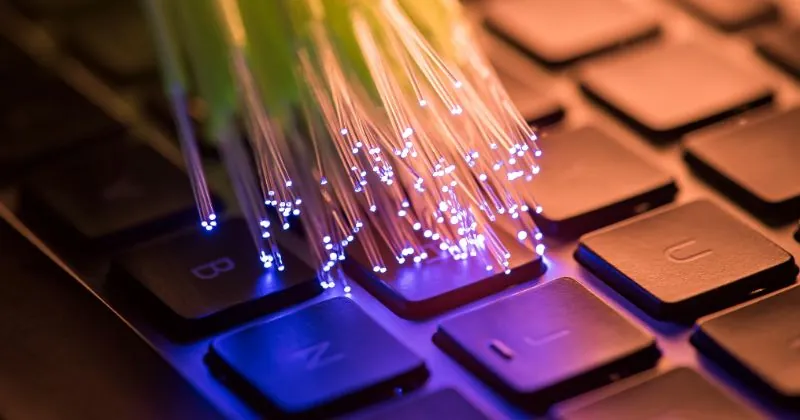
Fiber internet uses fiber-optic cables, which are tiny strands of glass that carry data using pulses of light. Yes… light.
That alone gives fiber a natural advantage over traditional internet technologies, which rely on electrical signals traveling through copper wires.
More light. Less interference. More speed.
It’s that simple.
So How Does Fiber Actually Work? (The Simple Version)
1. Tiny Strands of Glass Carry Light Signals
Each fiber strand is thinner than a human hair. When you send or receive data—like streaming a show or joining a video call—the information is converted into rapid beams of light.
2. The Light Bounces Its Way Through the Cable
Inside each fiber is a core surrounded by “cladding,” which reflects the light inward. So even if the cable bends, the signal stays intact all the way to your home.
This is why fiber delivers such reliable, consistent performance.
3. Your Equipment Turns the Light Back Into Data
When the signal reaches your home, a small device (an ONT—Optical Network Terminal) converts it from light into something your router can use.
That’s it—no signal loss, no slowdowns, no drama.
Why Fiber Is So Much Faster
When your data moves at the speed of light, it shows. Fiber internet delivers:
- Symmetrical speeds — fast uploads and downloads
- Lower latency — excellent for gaming, video calls, and smart home devices
- Better reliability — doesn’t slow down during peak hours like cable
- Future-proof performance — built for the ever-growing number of devices in our homes
This is why “how does fiber optic internet work?” is such a popular question… because once people experience it, they want to know why it’s so different.
Fiber vs. Cable: Here’s the Run Down
| Feature | Fiber Internet | Cable Internet |
| How It Works | Light through glass fibers | Electricity through copper wires |
| Upload Speeds | Fast, symmetrical | Much slower |
| Reliability | Extremely high | Can slow during peak times |
| Latency | Very low | Higher, especially with multiple devices |
| Future-Proof | Yes | No, infrastructure is aging |
If you’re tired of buffering, laggy calls, and “why is the Wi-Fi so slow?” fiber fixes all of that.
Is Fiber Internet Available in My Area?
This is the part where many people get jealous—fiber isn’t everywhere yet. But if you live in one of the communities LiveOak Fiber serves, you’re in luck. You can get the most advanced home internet technology available today, right at your doorstep.
And LiveOak Fiber is expanding rapidly across Florida and Georgia, so new neighborhoods are coming online all the time.
Why More Homes Are Switching to Fiber
Not only is fiber faster—it’s built for the way we live today. Think:
- Streaming live sports in 4K
- Multiple Zoom calls in one home
- Gaming without lag
- Smart homes full of connected devices
- Seamless uploads for work, school, and content creation
Fiber doesn’t struggle to keep up. It thrives.
The Run Down (In Case You Skimmed)
- Fiber internet sends data as light through glass cables
- It’s faster, more reliable, and more future-proof than cable or DSL
- It delivers symmetrical speeds, low latency, and rock-solid performance
- If you can get fiber where you live, it’s hands-down the best option